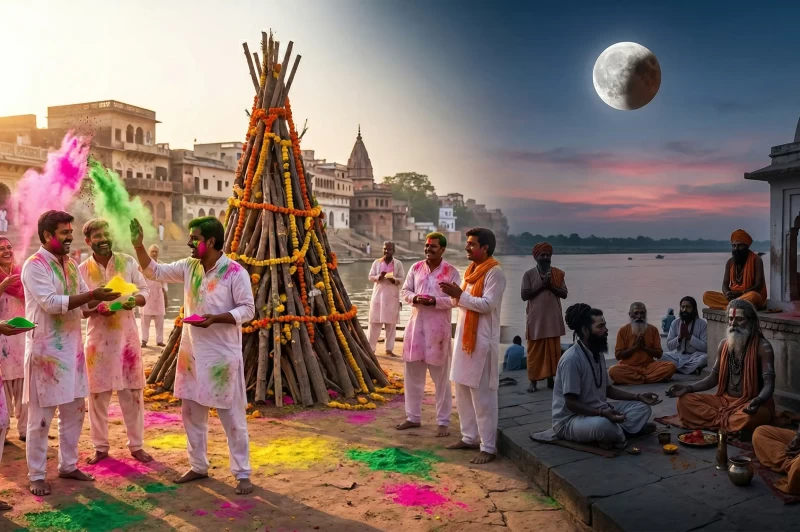
New Delhi/Mathura: The festival of Holi is a symbol of joy, colors, and the victory of good over evil. However, the year 2026 brings a rare celestial event coinciding with the festivities—a Total Lunar Eclipse. Occurring on March 3, 2026, during Phalguna Purnima, this eclipse falls precisely on the day of Holika Dahan. This has sparked significant astrological and religious debates: How will the eclipse affect the rituals? When should Holika Dahan be performed? Let’s look at the details.
Phalguna Purnima: Begins March 2, 2026, at 05:56 PM and ends March 3, 2026, at 05:07 PM.
Holika Dahan (Chhoti Holi): Traditionally performed during the Pradosh Kaal of Purnima.
Dhulandi (Main Holi): To be celebrated on the day after Purnima, March 4, 2026.
Total Lunar Eclipse: Occurring on March 3, 2026. In India, it will be visible during moonrise (Starting approx. 03:20 PM, peaking between 06:33–06:40 PM IST, and concluding by 06:47 PM). It will be most prominent in Eastern and North-Eastern India.
In Hindu scriptures, a Lunar Eclipse is considered inauspicious for starting new tasks. The Sutak Kaal (the period of restriction) begins 9 hours before the eclipse. During this time, idol worship, havans, and auspicious ceremonies are prohibited, and temple doors usually remain closed.
Key Astrological Factors this year:
Bhadra Kaal: From March 2, 05:58 PM to March 3, 05:30 AM. Auspicious works are avoided during Bhadra.
The Conflict: On March 3, due to the Eclipse and Sutak, standard puja and Holika Dahan cannot be performed during the daytime or early evening.
The Solution: According to scholars and prominent Panchangs (like Drik and Rishikesh), the most auspicious time for Holika Dahan is March 3, after the eclipse ends (from 06:22 PM to 08:50 PM). While some suggest March 2, the majority favor March 3 after the celestial purification.
Holika Dahan: Performing the ritual after the eclipse in the Pradosh Kaal is scripturally sound. Burning the Holika fire after the eclipse is believed to be even more powerful in destroying negativity.
Playing with Colors: Traditional celebrations, dancing, or playing with colors are restricted during the Sutak and Eclipse periods. Normal celebrations can resume fully after the eclipse ends.
Spiritual Advice: Many spiritual leaders, including Pujya Premanand Ji Maharaj of Vrindavan, suggest staying calm, meditating, and chanting mantras during the eclipse. Perform Havan and Puja only after the eclipse concludes.
A Lunar Eclipse affects the mind, emotions, and maternal energy. Occurring on Holi—a rare event happening after nearly 100 years—it signals a time for "Karmic Shifts," burning old baggage, and embracing new beginnings.
Avoid going outdoors or consuming food during the eclipse period.
Keep Basil (Tulsi) leaves in food items stored before the eclipse.
Take a ritual bath (Snan) after the eclipse ends and engage in charity (Daan).
Celebrate Holika Dahan with family, but strictly adhere to the Shubh Muhurat.
Conclusion: Holi 2026 will be unique, but the joy and colors will double after the eclipse passes. Follow the scriptures, stay safe, and celebrate with devotion. Radhe-Radhe and a very Happy Holi to all!