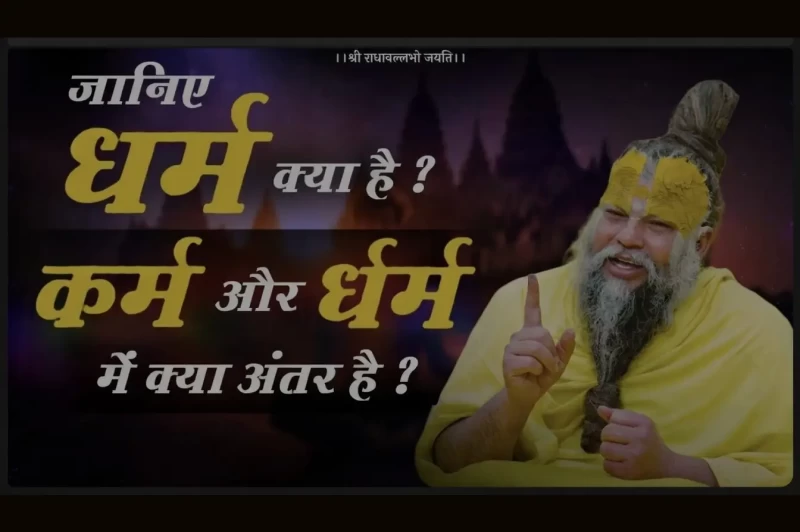
In today's era, there are many misconceptions regarding 'Dharma' (Righteousness/Duty) and 'Karma' (Action). People often ask: Is Karma greater or Dharma? Solving this deep query, Premanand Ji Maharaj clarifies that any action devoid of Dharma is not 'Karma,' but 'Kukarma' (an evil deed).
Maharaj Ji explains that from a scriptural perspective, Dharma and Karma are not separate. An action performed in accordance with Dharma is called 'Karma' (auspicious action). If an act goes against Dharma, it is categorized as 'Akushala Karma' or 'Kukarma'.
Example: The duty of an officer is to protect the innocent and punish the guilty. If he takes a bribe and releases the culprit, his action ceases to be 'duty' and becomes an evil deed.
There is a common belief in society that visiting temples or performing Aarti is the definition of being religious. Maharaj Ji sheds light on this, stating that rituals are merely a small part of Dharma.
The Scope of Dharma: From the moment you wake up until you sleep, and from birth until death, your every conduct should be imbued with Dharma.
Dharma in Every Gesture: How you speak, what you eat, and how you behave—all fall under Dharma. If you walk carefully so as not to harm a living being, or speak softly so as not to hurt someone’s heart, you are truly practicing Dharma.
Maharaj Ji cited two legendary examples to illustrate true Dharma:
The Sacrifice of Jatayu: Jatayu fought the mighty Ravana to protect Mata Sita. He risked his life, and because of this selfless act, he earned the privilege of resting in Lord Rama's lap and attained Vaikuntha. This was the fruit of his compassion, not just penance.
The Trial of King Shibi: To protect a pigeon that sought refuge, King Shibi carved out his own flesh to feed a hawk and eventually offered his entire body on the scales. He demonstrated that protecting those who seek refuge is the ultimate Dharma.
Maharaj Ji expressed deep concern over the rising misconduct in today's world:
Service to Parents: Abandoning parents in old age homes or mistreating them is the greatest sin against Dharma. Treating parents as divine is the core duty of a householder (Grihastha Dharma).
Preservation of Character: Criticizing the culture of 'live-in relationships' and unstable bonds, Maharaj Ji remarked that if character is lost, everything is lost. It is impossible to understand Dharma without a pure character.
Maharaj Ji’s message is clear: Dharma is not a single day's activity but a way of life. If we control our senses, maintain compassion for others, and perform our duties with honesty, then our every action will naturally become 'Dharma'.
Watch the full discourse here: What is Dharma? Difference between Karma and Dharma - Bhajan Marg
This article aims to spread Maharaj Ji's teachings to restore moral and ethical values in society.