When we think of historical spiritual exchanges between India and China, our minds instinctively wander to the serene images of Buddhist monks. We think of Xuanzang crossing perilous deserts to reach Nalanda, or Bodhidharma bringing Zen to the Shaolin Temple. For centuries, Buddhism has been celebrated as the primary bridge between these two ancient civilizations.
But if you leave the well-trodden mountain passes of the Silk Road and head south toward the bustling, salty ports of China's coast, a completely different story emerges from the earth.
Carved into gray granite stones, hidden inside ancient pagodas, and buried under layers of coastal soil lies a forgotten chapter of history: the deep, vibrant presence of Hinduism in ancient China.
Let's take a journey back in time to uncover how the chants of Vedic hymns once blended with the coastal winds of southeastern China.
The story of Hinduism in China doesn't travel over land; it rides the monsoon winds across the ocean. Archaeological and textual studies suggest that by at least the 2nd century CE, a small but influential presence of Hinduism had established itself in China.
During the Tang and Song dynasties, and reaching its absolute peak during the Yuan (Mongol) dynasty, southern Chinese port cities were the New York or London of the medieval world. They were dazzling, cosmopolitan hubs of global trade.
Indian merchants from powerful maritime guilds—particularly from the Chola Dynasty of South India—sailed across the Bay of Bengal and the South China Sea. They brought with them exquisite spices, fine textiles, precious stones, and their gods.
If there is a capital for Hindu history in China, it is undoubtedly Quanzhou (known historically to Westerners as Zaiton) in the Fujian province. During the 13th century, Quanzhou was one of the busiest ports on Earth.
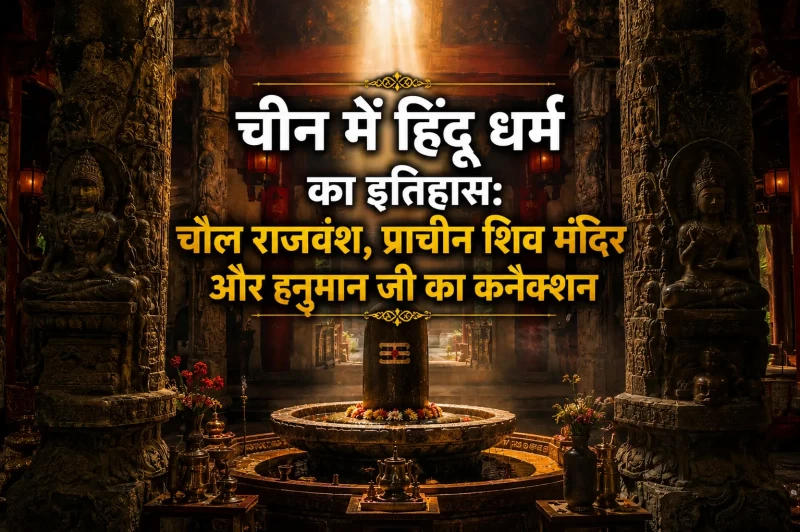
In this thriving city, the Indian merchant community didn't just build temporary shelters; they built magnificent, full-scale stone temples. Local records and archaeological finds reveal that Quanzhou was once home to a grand Hindu Temple dedicated to Lord Shiva, built in the traditional South Indian architectural style.
While the original Shiva temple was eventually lost to the sands of time and political upheavals, its fragments still tell its story. If you visit the famous Kaiyuan Buddhist Temple in Quanzhou today, you will experience an architectural mystery.
When the Kaiyuan Temple was rebuilt in the late Ming Dynasty, the builders utilized surviving stone pillars and carvings from the ruined Hindu temple. As a result, walking through this Chinese Buddhist sanctuary, you will suddenly come face-to-face with:
Granite pillars carved with intricate images of Lord Vishnu's avatars, including Narasimha (the man-lion) and Krishna subduing the serpent Kaliya.
Bas-reliefs depicting Shiva Lingams being worshipped by sacred cows and elephants.
Gorgons and mythical creatures that look completely at home in Thanjavur or Madurai, yet sit quietly under a Chinese pagoda roof.
The connection between Hindu culture and China isn't just written in stone; it is woven directly into the fabric of China's most beloved literature.
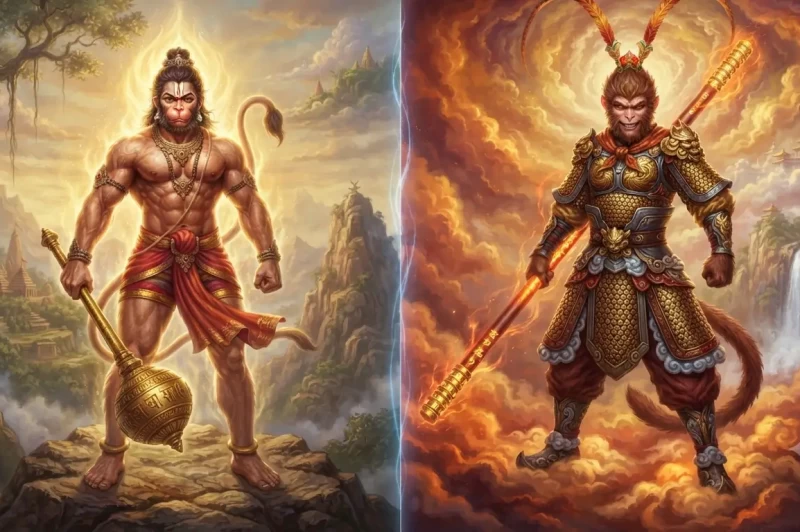
For decades, historians and literary scholars have debated a fascinating parallel: the striking similarity between Hanuman, the revered monkey deity from the Indian epic Ramayana, and Sun Wukong (The Monkey King), the legendary protagonist of the classic Chinese novel Journey to the West.
Both characters possess unimaginable strength, can fly on clouds, can change their size at will, and wield magical weapons to protect a holy traveler on a spiritual quest. Many scholars believe that oral retellings of the Ramayana, brought to Chinese ports by Indian merchants and sailors over generations, slowly evolved and merged with local folklore to give birth to one of China's most iconic cultural figures.
The history of Hinduism in China is a beautiful reminder that cultures in the ancient world were never rigidly isolated. They breathed together, traded together, and borrowed from each other’s imaginations.
The stone carvings of Quanzhou stand as a quiet, powerful testament to a time when an Indian merchant could sail thousands of miles across uncharted waters, settle on the shores of Fujian, and build a home where Lord Shiva was worshipped alongside local Chinese deities. It is a history written in granite—weathered by centuries, but entirely unforgettable.