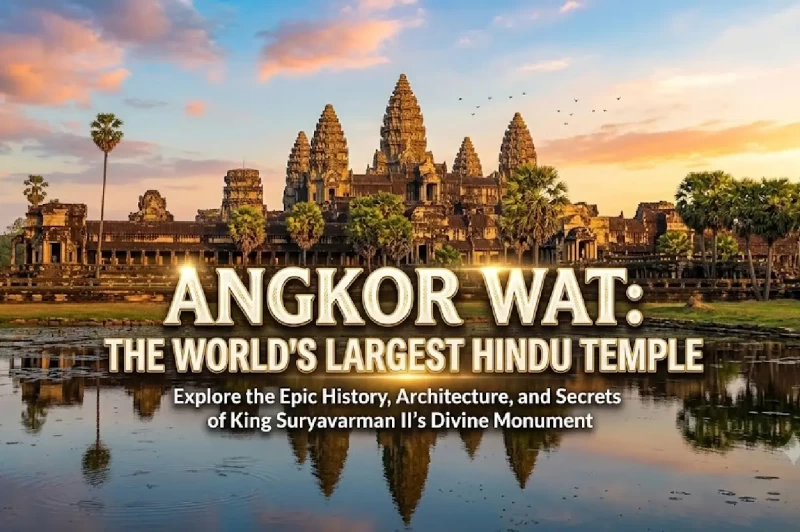
When we think of grand and massive Hindu temples, our minds instantly drift to the iconic architectural marvels spread across India. But did you know that the largest Hindu temple in the world is not located in India, but thousands of miles away in the Southeast Asian nation of Cambodia?
Yes, we are talking about the majestic Angkor Wat, which proudly holds the Guinness World Record for being the World's Largest Religious Monument. Spreading across a mind-boggling 500 acres (over 200 hectares), this monumental complex is not just a triumph of ancient engineering but also a timeless testament to the global footprint of Sanatan culture.
Let’s take a deep dive into the fascinating history of this mega-structure, the visionary king who built it, and the mysteries embedded in its stones.
Angkor Wat was constructed in the 12th century (roughly between 1112 and 1150 AD) during the golden age of the Khmer Empire by King Suryavarman II.
Dedicated to Lord Vishnu: Unlike most Khmer temples of that era which were dedicated to Lord Shiva, Angkor Wat was uniquely built as a grand dedication to Lord Vishnu. The Khmer kings viewed themselves as divine rulers and devout followers of Vishnu, creating this monument as their state temple and capital city.
The Buddhist Transformation: Towards the end of the 12th century, with shifting political dynamics and a change in rulers, Buddhism began to flourish in the Khmer empire. Gradually, this Hindu temple transitioned into a Buddhist shrine, which it remains today. This is why visitors can see a beautiful blend of both Hindu deities and Buddha statues harmoniously coexisting within the complex.
Angkor Wat isn't just massive; its architectural design and mathematical precision are so advanced that even modern engineers and scientists are left scratching their heads.
The entire layout of the temple is a physical replica of the cosmic universe according to Hindu mythology. The central complex features five towering lotus-shaped shikharas (spires) that perfectly symbolize the five peaks of Mount Meru, the sacred abode of the Devas.
Surrounding the entire temple complex is a colossal, square-shaped water moat that is about 650 feet wide. Mythologically, it represents the cosmic 'Ksheer Sagar' (Ocean of Milk) surrounding Mount Meru. Structurally and scientifically, this massive water body acts as a groundwater stabilizer, preventing the immense weight of the stone temple from sinking into the soft sand underneath.
The absolute highlight of Angkor Wat is its galleries, which feature kilometers of intricate bas-relief carvings. The massive stone walls vividly bring to life scenes from the Ramayana, the Mahabharata, the Churning of the Ocean of Milk (Samudra Manthan), and the various avatars of Lord Vishnu. The sheer level of detail in these thousands of carvings is breathtaking.
The West-Facing Mystery: The vast majority of Hindu temples face East (symbolizing the rising sun, life, and new beginnings). However, Angkor Wat uniquely faces West. In Vedic tradition, the West is associated with Lord Vishnu and the cosmic transition after life, leading historians to believe it was built both as a temple and a grand mausoleum for King Suryavarman II.
UNESCO World Heritage Site: Acknowledging its irreplaceable cultural and historical value, UNESCO declared Angkor Wat a World Heritage Site in 1992.
Pride of a Nation: The temple holds such an emotional and cultural significance for the people of Cambodia that it is proudly featured right in the center of the Cambodian National Flag.
The 8th Wonder of the World: Thanks to its jaw-dropping scale, unparalleled symmetry, and historical depth, it is unofficially celebrated globally as the Eighth Wonder of the World.
Today, Angkor Wat sits in a predominantly Buddhist nation, lovingly preserved by Buddhist monks, but its very foundation and soul remain deeply rooted in Sanatan Dharma. It stands as a living monument of a time when Indian cultural, artistic, and spiritual philosophies influenced civilizations far beyond its geographical borders. If you are a lover of history, architecture, or spirituality, visiting this glorious heritage in Cambodia is an absolute bucket-list experience!