Imagine a quiet temple morning, the scent of incense sticks wafting through the air. I stand there, and before me is a Brahmin deity, holding a simple-looking but sacred thread – the sacred thread. He has come to offer it to Lord Hanuman. A short while later, the Mahant arrives, and the conversation begins. The Brahmin says, "Last night there was a lunar eclipse; according to Vedic rituals, the sacred thread must be changed." The Mahant hesitates a bit, but is impressed by the Brahmin's humility and wisdom. Finally, with chanting, a new sacred thread is placed on Hanuman, and the old one is immersed in flowing water. This scene is so deeply etched in my mind that even today I wonder why the sacred thread is not just a thread, but the very thread of life that binds us and teaches us.
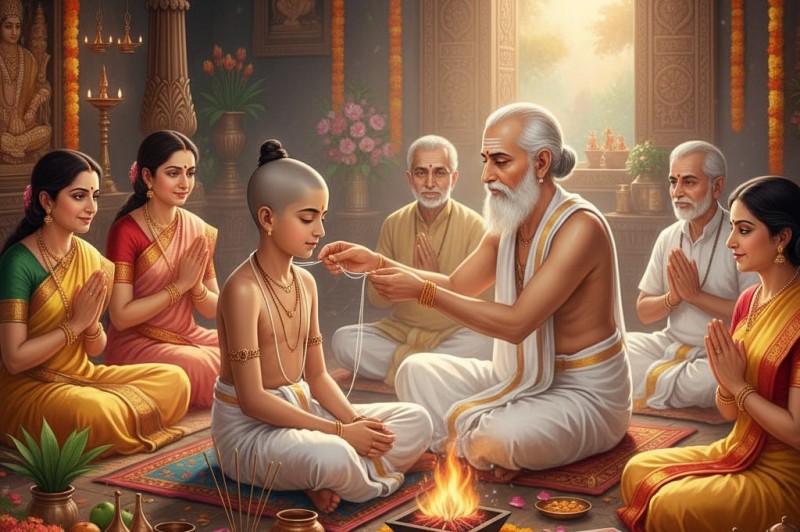
In Hinduism, the sacred thread, also known as the sacred thread of Yagyopavit, is a sacred thread made of three strands. It is one of the 16 sacraments (samskaras) – the Upanayana ceremony. Wearing it is considered a symbol of the second birth, making a person a 'Dwij' (twice-born). This means: the first birth is from the mother's womb, the second from the teachings of the Vedas by a guru. Only after wearing the sacred thread does a person gain the right to perform yagnas, read the Vedas, and perform religious rituals.
The sacred thread is made of cotton thread, consisting of three strands, each of which has three strands. These three strands symbolize the Trinity (Brahma, Vishnu, Mahesh), the three gunas (satva, rajas, tamas), and the three debts (pitru rin, dev rin, rishi rin). They are tied together by the Brahmagranthi (Brahma's knot).
Why is it worn? Because it symbolizes virtue, purity, and righteousness. Hindu scriptures say that wearing the sacred thread wards off evil forces, calms the mind, and leads one to spiritual life. The Hanuman Chalisa clearly states, "Haath Vajra aur Dhwaja Viraje, Kandhe Mooz Janeu Saaje." Lord Hanuman himself wears it, indicating that it is a symbol of celibacy and penance. For me, it reminds me that every bond in life grants freedom – just as the sacred thread binds, it liberates the soul.
The sacred thread is not a commodity, but is prepared using Vedic methods. I was stunned to hear that Brahmin's explanation. Let's learn the key rules:
These rules seem strict, but they embody the discipline of life. That day, while returning from the temple, I thought, "I too am a Brahmin; why shouldn't I adopt it?" I promised to meet the Brahmin God, and after coming home, I wrote in my old diary - "Wearing the sacred thread does not mean being bound, but being free from being bound."
In today's hectic life, the sacred thread reminds us that it is the small rituals that give life meaning. That Brahmin, whose eyes shone with reverence, that respect for the Mahant - all these are beautiful pictures of humanity. If we all performed our 'sacred thread' - that is, our duty - with such purity, how pure the world would become.
Writing this article felt heavy at heart. If you've ever changed your sacred thread, or if there's been a similar incident, please share it. Jai Shri Ram! Jai Hanuman!