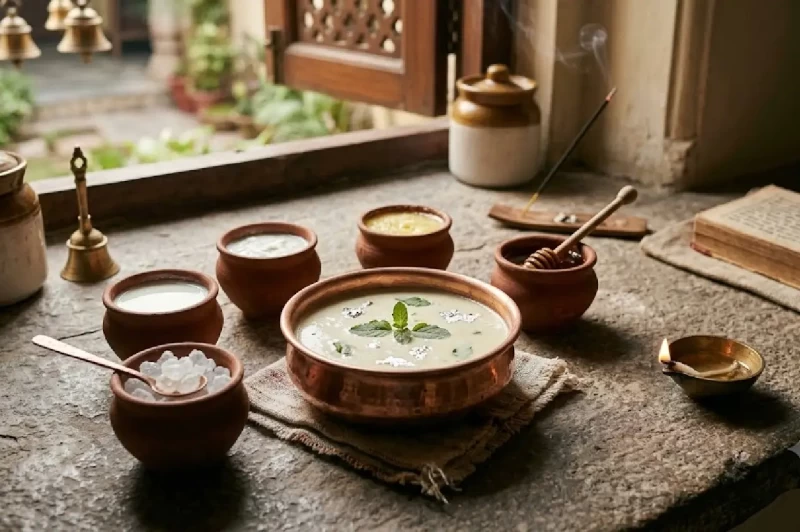
Every time you attend a puja, satyanarayan katha, or temple abhishek, a familiar tradition unfolds: the priest pours a single spoonful of cool, creamy, aromatic liquid into your cupped right hand. You sip it, gently touch your palm to your forehead, and move on.
To most of us, Panchamrit (or Panchamrutham) is simply charnamrit—a sacred prasad tied to devotion. But if you strip away modern routine and look closely at the wisdom embedded in Sanatan traditions, you discover something fascinating: long before the wellness industry invented probiotic shots and adaptogenic tonics, ancient India had already perfected one of the world’s most potent, bio-available functional foods.
The word itself explains its roots: Panch (five) and Amrit (nectar of vitality). It is not merely a ritual mixture; it is an alchemical blend where each ingredient balances the drawbacks of the other, creating an instant reset for gut health, cellular immunity, and cognitive clarity.
Ayurveda views Panchamrit as a restorative tonic designed to kindle Ojas—the subtle essence that governs physical strength, glow, and emotional immunity. Here is what each ingredient actually does within the body:
1. Raw Desi Cow Milk (Kshira) — The Cellular Builder
Symbolism: Purity and nourishment.
The Science: Traditional A2 milk contains easily digestible beta-casein proteins and healthy fats. It delivers bio-available calcium, essential amino acids, and conjugated linoleic acid (CLA), nourishing the body tissues (dhatus) without causing mucosal congestion when properly paired.
2. Fresh Curd (Dahi) — The Gut Restorer
Symbolism: Growth, prosperity, and patience.
The Science: Curd is packed with live lactic acid bacteria. It acts as an active probiotic, seeding the gut microbiome with good bacteria, strengthening the digestive fire (Jatharagni), and keeping opportunistic pathogens in check.
3. Pure Desi Cow Ghee (Ghrita) — The Bio-Carrier (Yogavahi)
Symbolism: Vitality, strength, and radiance.
The Science: Ghee is rich in butyric acid, a short-chain fatty acid that repairs the gut lining and lowers system-wide inflammation. In Ayurvedic pharmacology, ghee is a supreme Yogavahi—it acts as a lipid vehicle, carrying the nutrients of other ingredients deep into the body’s cell membranes.
4. Raw Honey (Madhu) — The Enzymatic Catalyst
Symbolism: Sweet speech, unity, and cohesion.
The Science: Unheated raw honey brings antimicrobial enzymes, flavonoids, and natural glucose to the table. In this formulation, it serves as a natural scraper (Lekhana) that helps prevent mucus accumulation while acting as a natural preservative.
5. Khand, Jaggery, or Mishri (Sharkara) — The Pure Energy Reserve
Symbolism: Bliss and sweetness of mind.
The Science: Traditional unrefined rock sugar (dhaga mishri) or raw desi khand acts as an instant brain tonic. It cools the system, offsets the heat of honey and curd, and provides an immediate source of glycogen to tired tissues.
In ancient medicine, balance was non-negotiable. Modern recipe books often treat Panchamrit like a dessert, tossing in heavy sugars and random amounts of ghee. But the classical scriptures provide a strict rule:
The Golden Ayurvedic Rule: Never mix equal parts of raw honey and ghee by weight.
When honey and ghee are combined in an exact 1:1 weight ratio, they form an indigestible complex (Ama) that can trigger metabolic toxicity. Sanatan rituals solved this centuries ago by using an asymmetrical formula:
Milk: 7 to 8 parts
Curd: 2 to 3 parts
Ghee: 1 part
Honey: 1/2 part (never equal to ghee)
Mishri/Khand: 1 part
When a few freshly bruised Tulsi leaves (Holy Basil) are added, the concoction gains adaptogenic compounds like eugenol, shielding the mixture from bacterial spoilage and enhancing respiratory endurance.
There is a deliberate reason you only receive a single spoonful of Panchamrit rather than a full glass: it is an elixir, not a meal.
Consumed on an empty stomach after morning meditation or prayer, this micro-dose triggers digestive enzymes without overwhelming the stomach. The fats in ghee cushion the stomach lining, the curd resets gut bacteria, the milk delivers calming tryptophan, and the honey-mishri blend gives the nervous system an immediate, calm boost of energy.
Our ancestors rarely separated daily wellness from spiritual reverence. They knew that if you called a compound "medicine," people might forget to take it; but if you tied it to sacred duty, devotion, and reverence for nature, generations would preserve the recipe without losing a single drop of its wisdom.
According to classical Ayurvedic texts (such as the Charaka Samhita), mixing ghee and honey in an exact 1:1 weight ratio creates an incompatible combination (Viruddha Ahara). Ghee has a cooling potency (Sheeta Virya), while unheated honey has a warming, dry nature (Ushna Virya). When combined in equal parts, their conflicting digestion rates impair digestive enzymes, forming an uneliminated metabolic toxin known as Ama. To prevent this, traditional Panchamrit formulations always use an asymmetrical ratio, typically keeping ghee higher in proportion than honey.
The ideal time to consume Panchamrit is in the morning on an empty stomach, preferably right after morning prayer or meditation. Because it is formulated as a concentrated functional tonic rather than a standard meal or beverage, the recommended serving is a micro-dose: 1 to 2 tablespoons (roughly 15 to 30 ml). Consuming it in this quantity allows the body to absorb live probiotics, healthy fats, and enzymes without burdening digestion.
While often confused due to their sacred roles in temple rituals, the two differ in ingredients and purpose:
Panchamrit: A prepared restorative mixture made strictly from five raw ingredients—cow’s milk, curd, ghee, honey, and jaggery/mishri—often energized with bruised Tulsi leaves. It is used for deity bathing (abhishek) and consumed as a nutritional prasad.
Charnamrit: Translates literally to "nectar from the feet" of the deity. It is traditionally water (often pure river or copper-charged water) infused with Tulsi leaves, camphor (kapur), and sandalwood, which has been poured over the sacred feet of the deity or Shaligram stone during worship.