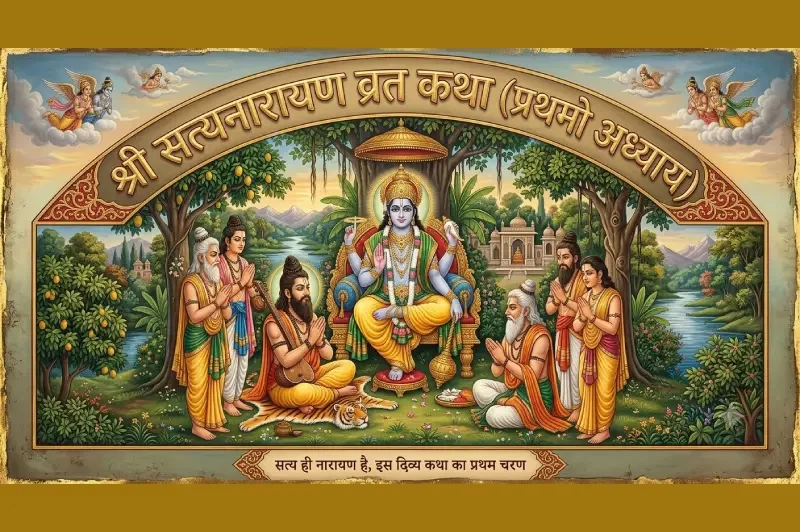
Om Shri Ganeshaya Namah |
Om Shri Gurubhyo Namah |
Om Shri Saraswatyai Namah |
Matri-Pitri Charana Kamalebhyo Namah.
Once upon a time, in the sacred pilgrimage site of Naimisharanya, Shounaka and other rishis (sages) and munis asked Shri Sutaji Maharaj, the connoisseur of Puranic scriptures : "O Mahamuni! We all wish to hear about the ritual (vrat) or austerity by which one can obtain their heart's desired fruits."
Shri Sutaji replied: "I am narrating exactly what Lord Shriman Kamalahapati (Vishnu) told Devarshi Narada when he asked a similar question. All of you, please listen attentively."
Once, the great yogi Narada, desiring the welfare of all living beings, was traveling across various realms and descended to the Earthly realm (Prithvi-loka). Here, he saw all living beings suffering from various types of miseries, grief, and afflictions according to the fruits of their past actions. Contemplating deeply on 'by what simple remedy can their sufferings be surely eliminated', he traveled to Vishnu-loka (the abode of Lord Vishnu).
There, he beheld the four-armed Lord Shri Narayana, adorned with the Shankha (conch), Chakra (discus), Gada (mace), Padma (lotus), and a forest garland (Vanamala), radiating a pure white complexion. Devarshi Narada began to pray to the God of Gods.
Narada said: "O Lord! You are beyond speech and mind, possessed of infinite powers, without beginning, middle, or end. You are untouched by the cosmic gunas (attributes) yet filled with all auspicious qualities, and You are the destroyer of Your devotees' miseries. I bow down to You."
After listening to the hymn, Lord Shri Vishnu asked Narada : "O noble soul! For what purpose have you come here? What is on your mind?"
Narada replied: "O Lord! All living beings on Earth, born into various lifecorms due to their sins, are suffering deeply from numerous afflictions. O Master! If You are pleased with me, kindly tell me by what simple remedy can their miseries be alleviated. Please reveal it to me."
The Supreme Lord said: "O dear child! Driven by the desire to bless the world, you have asked an excellent question. I shall reveal to you that sacred ritual by performing which a living being becomes free from all attachments and worldly illusions; listen. O dear child! There is a great ritual dedicated to Lord Satyanarayan, which is rare even in Heaven and on Earth. Out of affection for you, I am revealing it now. By performing the ritual of Lord Satyanarayan with proper rules and devotion, a person swiftly attains happiness in this world and ultimate salvation (moksha) in the afterlife."
Hearing the Lord's words, Narada asked: "O Lord, what are the fruits of performing this ritual? What is the correct procedure? Who performed it first, and when should it be performed? Please explain all of this in detail."
The Lord replied: "This Shri Satyanarayan Vrat destroys grief and sorrow, increases wealth and food grains, bestows good fortune, blesses with children, and grants victory everywhere. On any given day, a person filled with devotion and faith should perform the worship of Lord Shri Satyanarayan in the evening hours along with Brahmins, family members, and relatives."
"An offering (Naivedya) of high-quality edible items must be presented with devotion in a quantity of one-and-a-quarter (Savaya) measures. Bananas, ghee, milk, wheat flour (or if wheat flour is unavailable, Sathika rice flour), and sugar or jaggery—all these items must be collected in one-and-a-quarter measures and offered. After listening to the sacred story of Lord Shri Satyanarayan along with friends and relatives, one should feed the Brahmins. Everyone should devoutly partake of the holy offering (Prasad) and then organize devotional music and dance. Thereafter, remembering Lord Satyanarayan, everyone should return to their homes. By doing so, all desires of humans are certainly fulfilled. Especially in the era of Kali-yuga, this is the shortest and easiest remedy on Earth."
|| Thus ends the First Chapter of the Shri Satyanarayan Vrat Katha from the Rewa Khanda of Skanda Purana. ||