Every year, when the festival of Navratri arrives, a unique excitement and devotion awakens within. The twinkling lights in homes, the fragrance of incense sticks lingering in the air, and the beats of Garba drums—all of these create an atmosphere that touches the heart. But have we ever wondered why these nine days are so special? Why do we worship these nine forms of the Goddess, and what is the story behind this auspicious festival?
Navratri is not just a festival, it is a journey. A journey that connects us to the unparalleled power of Maa Durga and her infinite love. Every day, we welcome a new goddess, with a different form, a different significance, and a different story. These nine days remind us that success always triumphs over evil, and that true devotion is never thwarted.
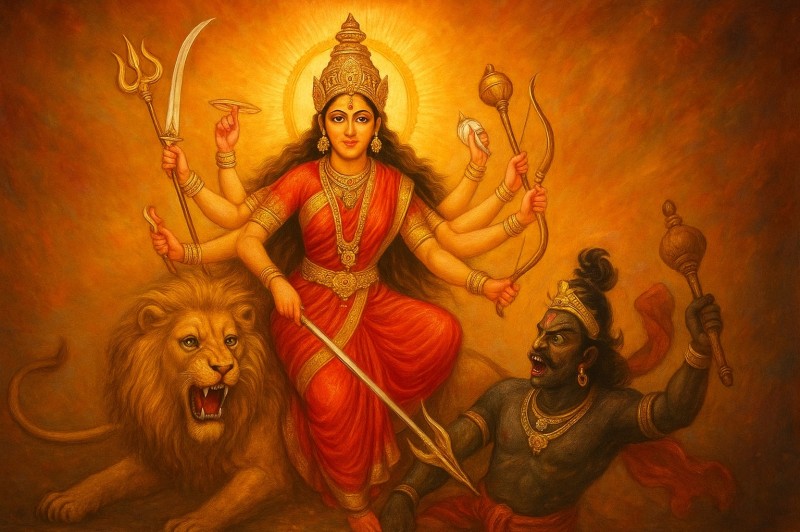
The most ancient and prominent story of Navratri is related to the demon Mahishasura. It is said that Mahishasura received a boon from Lord Brahma that no god or man could kill him. In his pride, he became so blinded by this boon that he attacked heaven and, after defeating the gods, seized the throne of Indra.
When the three worlds were troubled by his tyranny, all the gods united their powers. This gave birth to the great power – Maa Durga.
The great power embodies the radiance of Lord Shiva, the power of Vishnu, and the wisdom of Brahma.
Maa Durga fought a fierce battle with Mahishasura for nine days, and on the tenth day, she vanquished the demon. These nine days are celebrated as Navratri, and the tenth day is celebrated as Vijayadashami, just as we celebrate Dussehra, symbolizing the victory of good over evil.
Another popular story of Navratri is connected to the Ramayana. When Lord Rama was about to fight Ravana, the king of Lanka, he worshipped Mother Durga. It is said that Lord Rama worshipped Mother Durga for seven days, and on the tenth day, Mother Durga blessed him with victory. It was with this blessing that Lord Rama killed Ravana and ended the evil.
Therefore, the nine days of Navratri are considered auspicious for attaining power and victory.
Beyond the stories, Navratri also has a deeply emotional aspect. It reminds us that we too have a unique power hidden within us—a power that empowers us to overcome difficulties, overcome hopelessness, and inspire success in our lives.
When we worship the nine forms of the Mother Goddess, we truly awaken the strength, courage, wisdom, and compassion within ourselves. We resolve to defeat the Mahishasura within us (our ego, greed, anger) and take steps towards becoming a better human being.
So the next time you join in the Navratri celebrations, or perform the Aarti of the Goddess, remember these stories and sentiments. These are not just traditions; they are the testament of our ancestors, teaching us the path of strength and truth at every turn of life.
Wishing you all a very Happy Navratri! May the Mother Goddess bring happiness, peace, and prosperity to your lives.