Bhagavad Gita Chapter 6, Verse 46

Bhagavad Gita Chapter 6, Verse 46

This verse is from the Bhagavad Gita, Chapter 6, Verse 46. It is written in Sanskrit and translates to English as follows:

tapasvibhyo ’dhiko yogī jñānibhyo ’pi mato ’dhikaḥ
karmibhyaśh chādhiko yogī tasmād yogī bhavārjuna || 46 ||

English translation:

"O Arjuna! A Yogi is superior to ascetics, superior to wise men, and superior to those who perform rituals. Therefore, you become a Yogi."

Explanation in detail:

Lord Krishna is explaining the importance of Yoga to Arjuna in this verse. He tells that among the various paths of life, a Yogi has the highest place.

Why is a Yogi superior to ascetics?

  • The ascetic controls his body and senses and performs rigorous penance, but perfection is not attained by mere external penance.
  • The Yogi does not only suppress the senses, but also realizes God through self-knowledge and meditation, so he is superior to the ascetic.

Why is a Yogi superior to the wise?

  • The wise man only has knowledge of the scriptures, but if he does not apply that knowledge in life, he is incomplete.
  • The Yogi not only acquires knowledge, but also experiences that knowledge through meditation and sadhana. That is why he is superior to the wise man.

Why is a Yogi superior to Karmayogis?

  • The wise man has only the knowledge of the scriptures, but if he does not apply that knowledge in life, he is incomplete.
  • The Yogi not only acquires knowledge, but also experiences that knowledge through meditation and sadhana. That is why he is superior to the wise man.

Why is a Yogi superior to Karmayogis?

  • A Karmayogi only does karma, but if his karma is only for worldly success, then he is limited.
  • The yogi dedicates every action to God and works by combining meditation, knowledge and selfless action. Therefore, he is even superior to a Karmayogi.

Sanskrit word Meaning in English:

Tapasvibhyaḥ - From the ascetics, those who perform rigorous penance.
Adhikaḥ - Excellent, great.
Yogī - A practitioner practicing meditation, devotion, and self-realization.
Jñāṇābhyaḥ - From learned men, who are engaged only in the scriptures and the path of knowledge.
Api - Also.
Mataḥ - It is believed, it is understood.
Karmibhyaḥ - From Karmayogis, who are engaged only in karma (rituals).
Cha: - And.
Adhikaḥ - The best.
Yogi - One who practices yoga.
Tasmāt - Therefore.
Yogi Bhava - Become a Yogi, adopt Yoga.
Arjuna - Oh Arjuna!


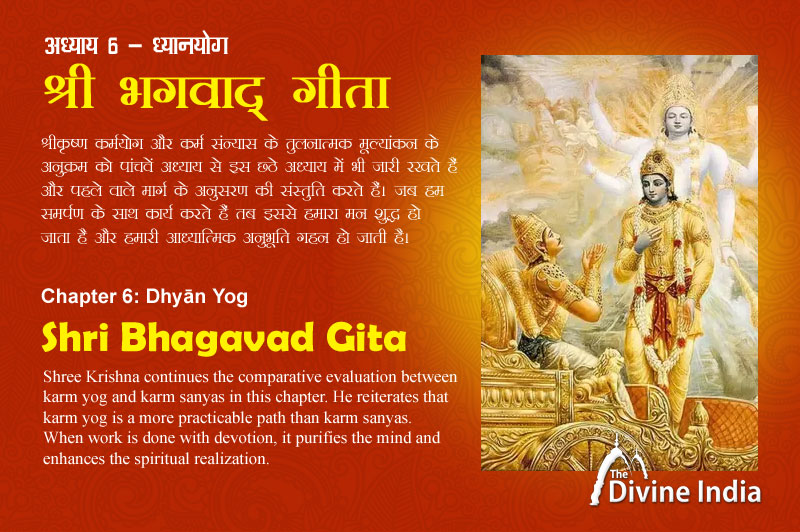
Chapter 6


Question and Answer


Upcoming Festivals & Vrat 2026


The Divine News


Humble request: Write your valuable suggestions in the comment box below to make the website better and share this informative treasure with your friends. If there is any error / correction, you can also contact me through e-mail by clicking here. Thank you.

EN हिं